
Climate Change as a Threat to Representative Democracy
Starting point:
Views on anthropogenic climate change (ACC) as well as climate policy measures (e.g., wind turbines) have in recent years contributed to a polarization at the societal level (Otteni and Weisskircher, 2022; Zilles and Marg, 2022). Given the documented dangers of polarization for democracy, it is essential to examine the polarization of attitudes towards climate change and related policies. A significant yet underexplored question is whether the polarization evident in the general public also exists among (local) political elites, especially given the climate change skeptic views voiced by the AfD (Küppers, 2022).
Studying political elites’ views on ACC is, moreover, relevant for three practical reasons: 1) existing scholarship indicates that acknowledging ACC is a necessary precondition for supporting climate change mitigation policies (Fielding et al., 2012; Rapeli & Koskimaa, 2022; Tranter, 2011); 2) political elites are the primary decision-makers in climate change mitigation; 3) skeptical views held by political elites can influence the general public, potentially increasing climate change skepticism and policy resistance.
Climate change may challenge representative democracy in another way. Actions such as the blockades of highway exits and main traffic lines by the activists of the “Last Generation” may be regarded as an indicator of the lost faith in the effectiveness of conventional forms of political participation in parts of the climate movement. This discontent could indicate a broader dissatisfaction with the current state of representative democracy. Moreover, dissatisfaction with how political elites have handled the climate crisis thus far could lead to decreased support for (certain aspects) of representative party democracy.
Research question: How does man-made climate change challenge representative democracy?
Approach:
This project has two sub-projects. The first will study political elites’ attitudes towards climate change and specific climate policies through a web survey of local and regional MPs in the East German states of Saxony and Thuringia – both of which are strongholds of the climate change skeptic far-right AfD and battlegrounds for local conflicts over the energy transition. The second sub-project will examine how fear of climate change shapes attitudes towards and support for representative democracy.
Funded by: ProChance-career Research Grant, University of Jena.
Start date: 01.12.2022.
Project status: ongoing.
Science Skepticism and the Role of Political Ideology
This project will systematically examine the link between political ideology and science denial (using climate change skepticism and COVID-19 skepticism as examples). Throughout the project, I will employ qualitative data analysis (e.g., studying the framing of climate change or the COVID-19 pandemic in the party communication of populist radical right parties) as well as quantitative methods (e.g., to study the attitudes of citizens and political elites with survey data).
The results of this project are of high practical and scientific relevance: In contrast to the US or several East European states, where a sizeable share of the population does not believe in climate change, the share of climate change deniers in Germany is (still) relatively small. There is, however, the risk that the climate change skeptic views of the Alternative for Germany (AfD) will ‘trickle down’ into its electorate. Through the parallel developments of an increasing salience of climate change for electorates and the increasing popularity of (often) climate change skeptic radical right-wing parties throughout Europe, climate change skeptic arguments could become a vital strategy to mobilize specific voter segments. Moreover, this project contributes to an ongoing academic debate were, e.g., Huber (2020) claims that the populist radical right’s climate change denial derives from populism, while Kulin et al. (2021) argue that nationalism is more important.
Regarding the COVID-19 pandemic, false claims that negate or trivialize the threat posed by the virus have been prominent. Understanding the explanatory factors of these sceptic attitudes is of high relevance: Studies document that Corona skeptics are less likely to adopt preventive behavior and oppose political measures to mitigate the pandemic. This also implies that these individuals can become ‘critical disease vectors’ (Latkin et al., 2021) if they get infected. Moreover, it has been suggested that the Anti-COVID protests can provide a fertile ground for radicalization (see e.g., Grande et al. 2021).
Project status: ongoing.
Publications associated with this project:

Küppers, A. & Reiser, M. (2022) Ideological Extremism or Far-Right Attitudes? The Role of Ideology for COVID-19 Scepticism, Representation 58(4), 481-499.
Cites: 33 (Google Scholar)
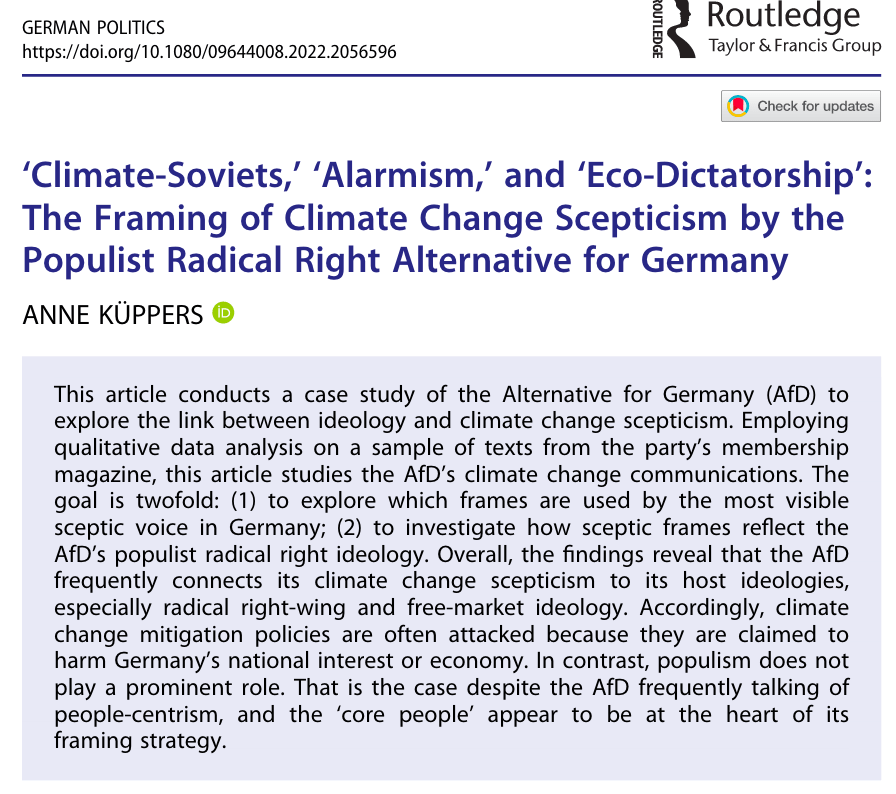
Küppers, A. (2022) ‘Climate-Soviets,’ ‘Alarmism,’ and ‘Eco-dictatorship’: The Framing of Climate Change Scepticism by the Populist Radical Right Alternative for Germany, German Politics, Online first.
Cites: 102 (Google Scholar)
 Dr. Anne Küppers